How to reduce knee pain naturally, the JointsAid way

Updated September 2026 · reviewed by the JointsAid Research Team. We are an independent information resource, not a medical provider, and this article is educational rather than medical advice.
To reduce knee pain naturally means using low-impact movement, targeted leg strength, weight management and joint-friendly nutrition — and, if you choose, well-studied nutrients like glucosamine and turmeric — to help a sore, stiff knee feel and function more comfortably (Messier SP et al., JAMA, 2013). The knee is a hard-working, weight-bearing joint, so small daily habits that build the muscles around it and lighten its load tend to help the most.
How to reduce knee pain naturally, in one place.
- The goal
- Calmer, steadier knees so stairs, squats, walks and standing feel less like a negotiation.
- Biggest levers
- Low-impact movement and quadriceps/hip strength matter most, followed by a comfortable weight and an anti-inflammatory diet.
- Move the knee
- Gentle, regular motion nourishes cartilage and circulates joint fluid; complete rest usually stiffens a sore knee further.
- Where supplements fit
- Nutrients such as glucosamine, chondroitin, collagen, turmeric and boswellia can support the routine but are not a treatment for any disease.
- Timeframe
- Warmth and mobility can help the same day; strength, weight and nutrition changes usually show over weeks to months, and results vary.
If your knees announce themselves on the stairs, protest when you rise from a low chair, or ache after a long day on your feet, you already know the knee is a joint that earns its keep. It carries most of your body weight, bends and straightens thousands of times a day, and depends heavily on the muscles around it. The good news is that the knee also responds well to the everyday habits below. This guide is knee-specific — distinct from our broader look at relieving joint pain naturally — and it shows where a daily formula like JointsAid can play a supporting role.

What does it mean to reduce knee pain naturally?
Reducing knee pain naturally is the practice of using movement, muscle strength, weight management, nutrition and sensible self-care to help the knee feel and function better — without reaching first for anything harsh. It is not a cure, and it does not replace medical care for a diagnosed condition such as osteoarthritis or a ligament injury. It is a stack of small, repeatable choices that keep everyday stiffness and ache gentler. Two ideas anchor everything below: the muscles around the knee are your best natural shock absorbers, and consistency beats intensity — a little most days outperforms an occasional heroic effort.
Why do knees hurt more than other joints?
The knee hurts easily because it is a large, weight-bearing hinge caught between the long levers of the thigh and shin, so it absorbs and redirects big forces every time you walk, climb or squat. Cartilage cushions the joint and a thin layer of fluid lubricates it, but the cartilage has no blood supply of its own and depends on movement to stay nourished. Add the ordinary influences — years of use, past sports or work injuries, extra body weight, and weak quadriceps or hips — and the familiar picture appears: morning stiffness, a twinge on the descent, an ache after standing (Fransen M et al., Cochrane Database of Systematic Reviews, 2015). None of that means you should stop moving. The knee is living tissue that responds to gentle, regular demand, and under-use tends to stiffen it faster than sensible activity.
What are the best natural ways to reduce knee pain?
The best natural ways to reduce knee pain are the everyday ones, and they are listed here roughly in order of impact. You do not need all of them at once; each one helps a little, and together they compound.
1. Choose low-impact movement most days
The single most reliable thing you can do for a stiff knee is to keep using it gently. Movement circulates the fluid that lubricates the joint and helps nourish cartilage that has no blood supply of its own. Low-impact activity is ideal because it moves the knee through its range without pounding it: walking on level ground, stationary or outdoor cycling, swimming or water walking, and gentle mobility drills (Wang C et al., Annals of Internal Medicine, 2016). Aim for regular, moderate sessions rather than occasional heavy bursts, and build up slowly as comfort allows.
2. Strengthen the quadriceps, hips and hamstrings
Strong leg muscles act like shock absorbers, taking load off the knee itself, so building them is arguably the highest-value habit on this list. The quadriceps on the front of the thigh control the knee directly, while strong hips and hamstrings keep the joint tracking correctly. Simple, knee-friendly moves — sit-to-stands from a chair, straight-leg raises, wall sits, step-ups and gentle banded work — done twice a week can make stairs and standing noticeably easier over a few weeks.
3. Reach and hold a comfortable weight
Because each extra pound of body weight adds roughly three to four pounds of force through the knee with every step, weight is uniquely important for this joint. This is not about a crash diet; it is about steady habits — more whole foods, sensible portions and regular movement — that quietly lighten the load the knee carries all day. Even a modest, sustainable reduction can ease that daily burden.
4. Eat an anti-inflammatory, collagen-friendly diet
What you eat is part of the picture. A pattern rich in vegetables, fruit, oily fish, nuts, olive oil and whole grains supplies the antioxidants and healthy fats associated with a calmer inflammatory balance, while collagen and vitamin-C-rich foods provide raw materials the body uses in connective tissue. We cover this in depth in our guide to the best foods for joint health.
5. Use heat, cold, footwear and rest wisely
Warmth — a heat pack, a warm shower, gentle morning mobility — loosens a stiff knee, while cold can calm a knee that feels hot or swollen after activity. Supportive, cushioned footwear reduces the jolt that travels up to the joint, and pacing a busy day, breaking up long standing, and protecting seven to nine hours of sleep all give the knee time to recover. Small ergonomic tweaks, like avoiding deep, sustained squatting on a sore knee, add up.
| Knee-friendly move | What it supports | Simple starting point |
|---|---|---|
| Sit-to-stand | Quadriceps & everyday getting up | 2 sets of 8–10 from a firm chair |
| Straight-leg raise | Quads without bending the knee | 2 sets of 10 per leg, lying down |
| Wall sit | Quad endurance & joint stability | Hold 10–20 seconds, build slowly |
| Step-up | Stairs & single-leg control | Low step, 6–8 per leg |
| Stationary cycling | Range of motion, low impact | 5–10 easy minutes, light resistance |
See what JointsAid actually names →
Which supplements and vitamins help sore knees?
Supplements for knee pain are a support to the habits above, not a substitute, and never a treatment for any condition. Still, a handful of nutrients have long been part of the joint-wellness conversation, and several appear together in JointsAid. Think of them as raw materials and companions to movement rather than a shortcut around it.
| Supplement / vitamin | Why it is discussed for knees | Traditional / general role |
|---|---|---|
| Glucosamine | Cartilage building block | A naturally occurring component of cartilage; one of the most studied nutrients in knee routines. |
| Chondroitin | Cartilage component | Helps cartilage retain water and cushioning; frequently paired with glucosamine. |
| Type II collagen | Connective-tissue protein | A structural protein of cartilage, popular in modern joint-comfort blends. |
| MSM | Source of sulfur | Supplies sulfur the body uses in connective tissue; a common comfort-blend companion. |
| Turmeric & boswellia | Culinary & Ayurvedic botanicals | Curcumin and frankincense resin, both with long traditions of use for everyday comfort. |
| Vitamin C, D & omega-3 | Vitamins for sore knees | Vitamin C aids collagen formation, vitamin D supports bone, and omega-3s support a calmer balance. |
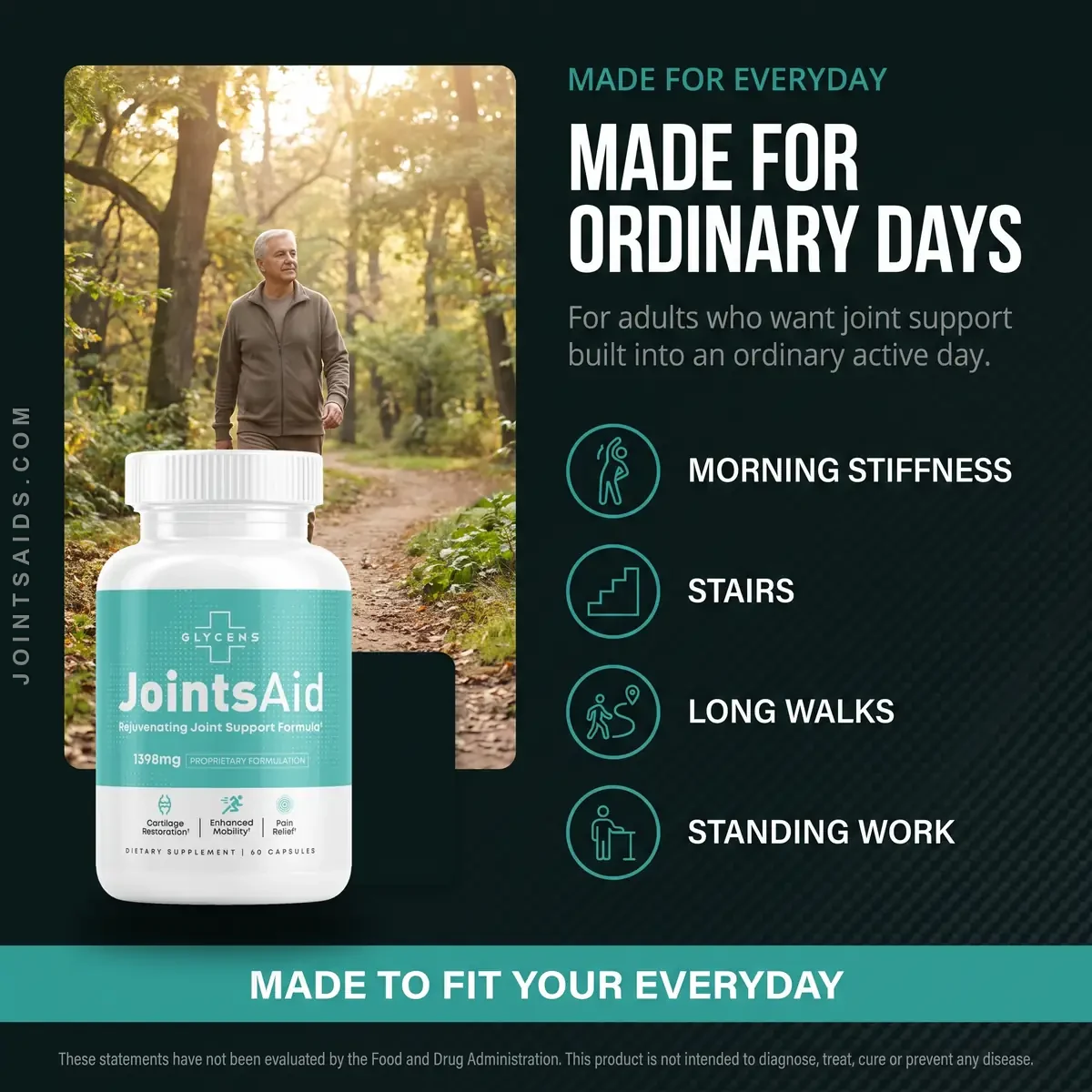
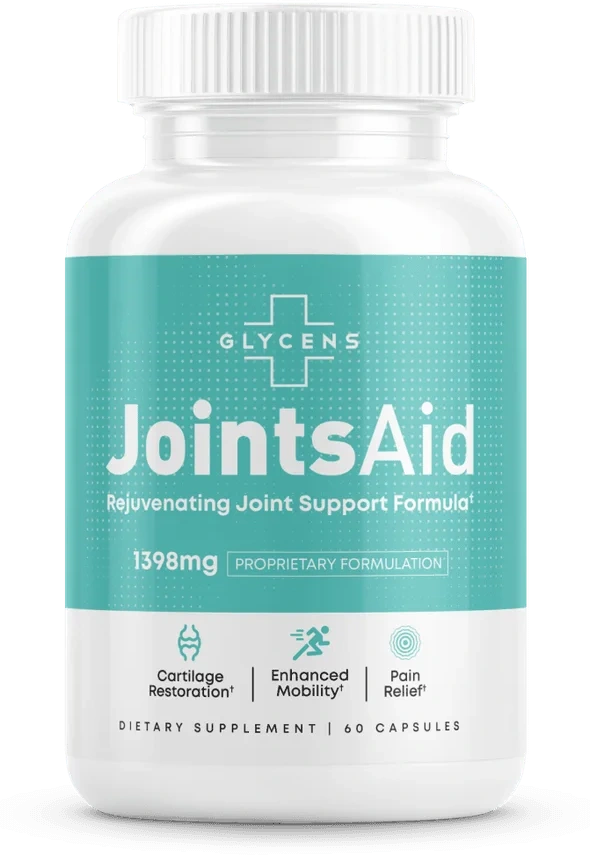
JointsAid brings the core of these together: the cartilage building block glucosamine plus a 1,398 mg proprietary blend that layers in turmeric, MSM, quercetin and boswellia serrata, delivered as a simple daily capsule. For a closer look at the headline pair, read our guide to glucosamine and chondroitin for joints, or see the full ingredients section. Whatever you choose, remember these are supplements for sore knees, not medicines, and evidence for individual nutrients ranges from encouraging to mixed.
Make knee support a daily habit
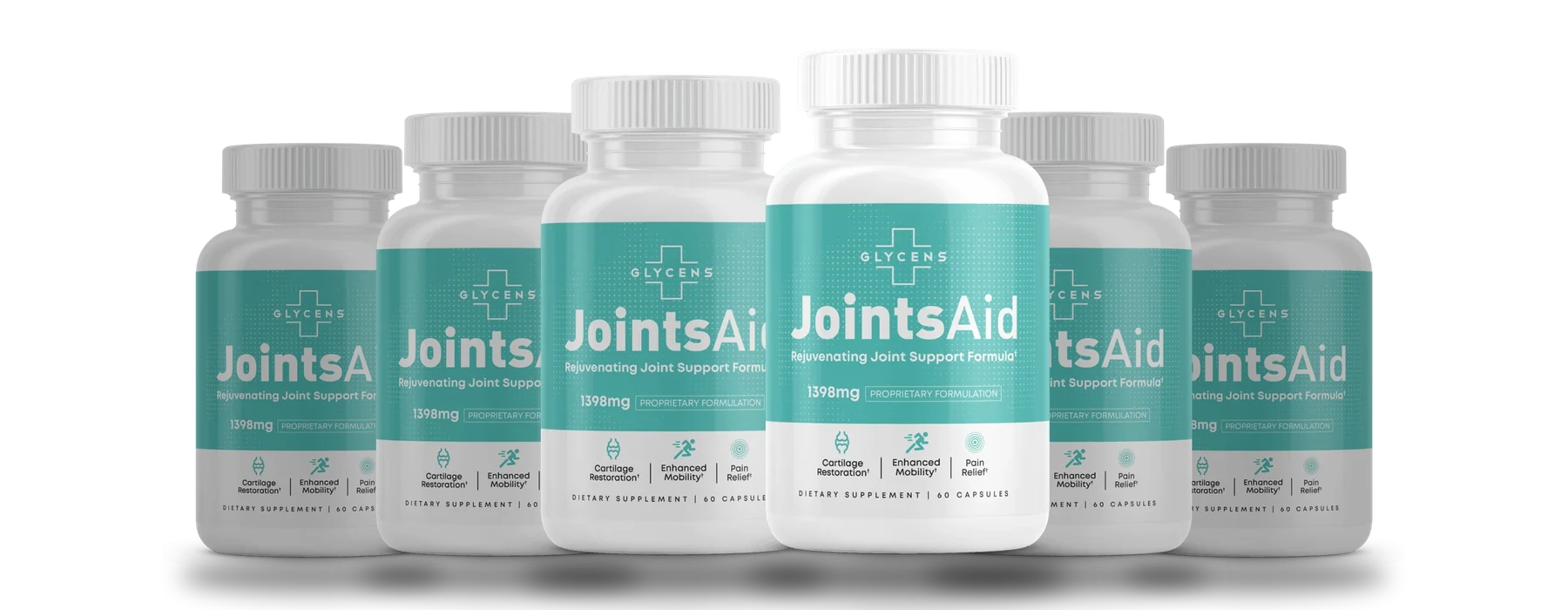
JointsAid is a once-daily routine pairing cartilage nutrients with a 1,398 mg proprietary formulation. The six-bottle bundle is the best value at $49 per bottle, with free U.S. shipping and a 60-day guarantee — check today's JointsAid pricing before you build your routine.
Order JointsAid — from $49/bottleHow do you build a simple daily knee routine?
The best knee routine is the one you will actually keep, so stack one small habit at a time until each feels automatic rather than overhauling everything at once. A workable day looks like this:
- Start with gentle mobility — a few minutes of easy knee bends and marches to shake off morning stiffness.
- Walk most days on level ground, building distance slowly as it feels comfortable.
- Add two short strength sessions a week for the quadriceps, hips and hamstrings.
- Build meals around vegetables, oily fish and whole foods, and keep portions sensible.
- Use warmth in the morning and cold after hard activity, and protect a consistent bedtime.
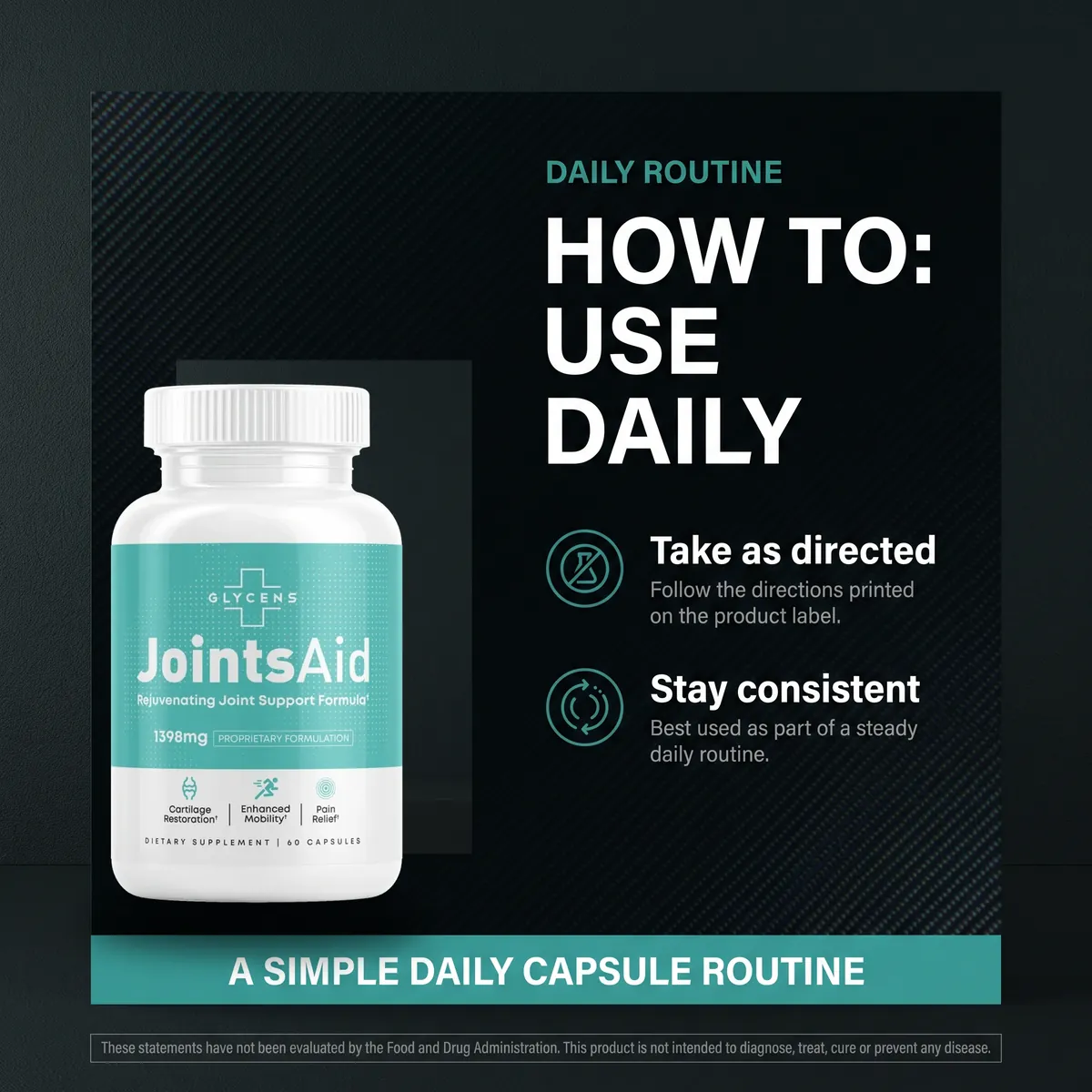
- Take any supplement at the same time daily — for JointsAid, the labelled serving with a meal.
How fast will your knees feel better?
A “fast” habit is one you may feel within a day; a “slow” habit reshapes your baseline over weeks. Both matter for the knee. This table sorts the core habits by how quickly they tend to help and how much effort they ask.
| Habit | Typical time to notice | Everyday effort |
|---|---|---|
| Warmth & gentle morning mobility | Same day | Low |
| Pacing, footwear & breaking up standing | Same day | Low |
| Regular low-impact movement | Days to weeks | Low |
| Anti-inflammatory, whole-food diet | Weeks | Medium |
| Quadriceps & hip strengthening | Weeks | Medium |
| Reaching a comfortable weight | Weeks to months | Higher |
Consistency turns any of these into a steadier month. Joint nutrients build their support gradually, so most people choose a multi-month supply to avoid running out mid-routine — compare the packages and pricing on the homepage.
When should you see a doctor about knee pain?
Natural habits are for supporting everyday knee comfort; they are not a replacement for medical care. See your doctor if a knee is hot, red or badly swollen, if it locks, gives way or cannot bear weight, if pain follows a fall or twist, if there is significant instability, or if stiffness and pain persist despite sensible self-care. Mention any diagnosed condition or medication before starting a new routine, and because glucosamine is often shellfish-derived, flag any shellfish allergy before taking a joint supplement.
Frequently asked questions
How can I reduce knee pain naturally at home?
Focus on the levers with the most influence: gentle low-impact movement most days, two short sessions a week that strengthen the quadriceps and hips, reaching a comfortable weight, and an anti-inflammatory diet. Warmth in the morning and cold after activity help in the moment. Well-studied joint nutrients such as glucosamine and turmeric can support the routine but are not a treatment.
Which exercises are safest for sore knees?
Low-impact options are safest because they move the knee through its range without pounding it: walking on level ground, stationary or outdoor cycling, swimming or water walking, and gentle strength moves like sit-to-stands, straight-leg raises and wall sits. Build up slowly and stop anything that causes sharp pain.
What supplements or vitamins help sore knees?
The most discussed supplements for knee pain are glucosamine and chondroitin, MSM, type II collagen, turmeric and boswellia, while vitamins C and D and omega-3s support connective tissue and a calmer inflammatory balance. They are a support to movement and diet, not a cure, and people on medication or with a shellfish allergy should ask a doctor first.
How long does it take to reduce knee pain naturally?
Warmth, pacing and gentle mobility can ease a stiff knee the same day, while strengthening, weight and nutrition changes usually show over several weeks to a few months. Joint nutrients build their support gradually, and individual results vary.
Does losing weight really help knee pain?
For the knees, yes. Because each extra pound of body weight adds roughly three to four pounds of force through the knee with every step, even a modest, sustainable reduction can meaningfully ease the daily load the joint carries.
When should I see a doctor about knee pain?
See a doctor if a knee is hot, red or badly swollen, if it locks, gives way or cannot bear weight, if pain follows an injury, or if stiffness and pain persist despite sensible self-care. Natural habits support everyday comfort but do not replace medical care for a diagnosed condition.
Check today's JointsAid pricing — risk-free for 60 days →
JointsAid is a dietary supplement, not a treatment for any medical condition. These statements have not been evaluated by the Food and Drug Administration. This product is not intended to diagnose, treat, cure or prevent any disease. Always consult a qualified healthcare professional about your individual needs.
References & further reading
- National Institute of Arthritis and Musculoskeletal and Skin Diseases (NIAMS). Osteoarthritis — Overview. niams.nih.gov/health-topics/osteoarthritis
- National Center for Complementary and Integrative Health (NCCIH). Glucosamine and Chondroitin for Osteoarthritis. nccih.nih.gov/health/glucosamine-and-chondroitin-for-osteoarthritis
- Mayo Clinic. Knee pain — Symptoms & causes. mayoclinic.org/diseases-conditions/knee-pain
- Mo L et al., Orthopaedic Journal of Sports Medicine, 2023. Exercise therapy for knee osteoarthritis: a systematic review and network meta-analysis. Mo L et al., Orthopaedic Journal of Sports Medicine, 2023 — PubMed 37346776
- Examine.com. Curcumin — evidence-based summary. examine.com/supplements/curcumin
- Fransen M et al., Cochrane Database of Systematic Reviews, 2015. Exercise for osteoarthritis of the knee. Fransen M et al., Cochrane Database of Systematic Reviews, 2015 — PubMed 25569281
- Messier SP et al., JAMA, 2013. Effects of intensive diet and exercise on knee joint loads, inflammation, and clinical outcomes among overweight and obese adults with knee osteoarthritis: the IDEA randomized clinical trial. Messier SP et al., JAMA, 2013 — PubMed 24065013
- Wang C et al., Annals of Internal Medicine, 2016. Comparative Effectiveness of Tai Chi Versus Physical Therapy for Knee Osteoarthritis: A Randomized Trial. Wang C et al., Annals of Internal Medicine, 2016 — PubMed 27183035
These references describe the ingredients and habits in general terms and do not constitute evidence that any product treats, cures or prevents any condition.
Keep reading: how to relieve joint pain naturally · the best foods for joint health · back to the JointsAid blog · the JointsAid review.